


Dinner with Carapace
An interview with Flora Molinié, director of Carapace
 Carapace seems to consist of drawings placed on a filmed image. Did you shoot the movie on film? If not, what digital technique did you use to superimpose the drawings on the image? How much time did it take you to make the film with these different steps?
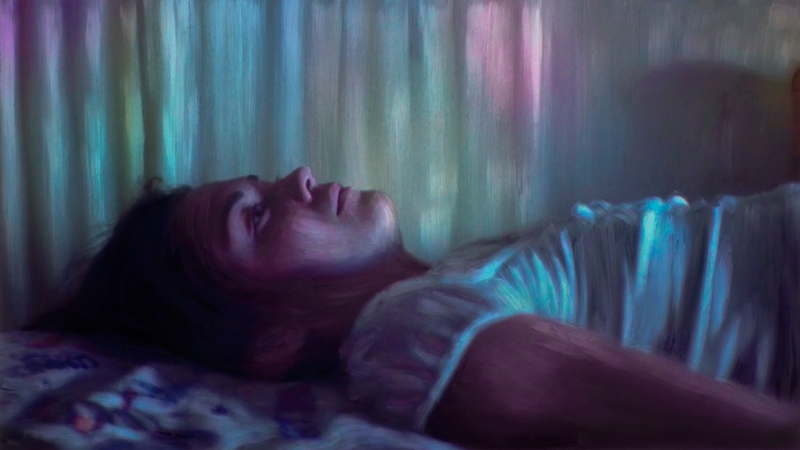
Carapace is a hybrid object between painting on glass and video. We shot the entire film with the actors, then the video images were projected on a plate of glass and painted with oil paint. Each completed image is then photographed before being changed, by modifying and repainting the moving parts in order to create movement.
The animated painting is a very tedious technique: you need about 400 paintings a minute. To make this film with this “film under the film” technique took one year of intense work, 10 months of which for the animation.
In Carapace, you deal with a very raw question on the sexuality of couples. Generally, sex is considered an instinctive act that doesn’t require explanations or education. Carapace seems to support the contrary. Do you have a particular conviction on the question of how “innate” the sexual act is?
No, I don’t have a particular conviction on that. Although, I think that we don’t all relate to sex the same way. It is a very personal thing, and if it may seem instinctive to some, for others it could well seem complicated or even impossible. For women especially, without wanting to make any generalizations, the “first time” is often associated with pain, with blood, with the loss of something whereas from a male point of view it is generally the exact opposite, it is pleasure, accomplishment, even if anxiety exists on both sides. All of that of course is conveyed through constructs that still exist within our society.
Where did you get the idea for Carapace? Did you conduct research or interviews on the question of people living in couples without sexual relations?
My first contact with the subject of this film came about when a couple of close friends confided in me. I discovered the existence of this sexual dysfunction when they shared their intimacy problems with me. My friend lived with this mental block that plagued her daily life, her mind had become a rival to her body, this body refusing to accept a normal sexual relationship. Her story was touching and it was above all the story of that battle between a woman and her body that I wanted to tell, and which was also for me a true question of staging. I spoke to her consulting doctor who gave me the name of this condition: vaginismus. He described this sexual and relational problem as an uncontrollable protective reflex. He then guided me in the direction of the association “Les Clés de Vénus” (The Keys of Venus), which was composed of men and women who had encountered this kind of problem and which allowed women to express themselves and share with each other. It was then that I realized just how many women lived with this battle, and how important it was to talk about it. So, it was these encounters and the testimony I heard that led me to the story of Lili and Léo and their path as a couple forced to live with an incomplete sex life.
The animated part of the film adds emphasis to the film sequences through pronounced effects which are immediately associated with emotions such as delirium, confinement, metamorphosis. Your animated work seems to illustrate the film with feelings linked to the story, creating an intermediary effect which seems to deliver the content, a bit like a storyteller adds voice intonation and body language to deliver his story. Do you see this as a narration?
In Carapace, the different layers of paint create a sense of modesty, making the image less brutal by establishing a distance, which allows us to enter the intimacy of the couple who face the spectator, naked, without it becoming voyeuristic. The paint is like a soft veil over a story that could be perceived as raw or trivial. It is also a means to sublimate and give a certain dreamlike quality to the narration which itself is quite down-to-earth.
When Lili confronts her own body, we tumble into a deformed vision, with quite unreal images, through a passage between painting and video which reveals the technique. In those images, which are like sensations, the image is almost frozen like a photograph, with a very long pause that gives an impression of ghostly movement. The atmosphere of those images is very intimate, cloudy, almost as if surrounded by a thick fog. Lili’s body floats in that soft and protective yet oppressive universe. It contracts into a protective position, closed in on itself, as if it had been attacked.
In Carapace, you essentially play on the relationship of the adult woman with her status as a child, of the little girl with the baby she once was, as if the woman was trapped in a candy pink bubble. Do you think that today in France, almost 50 years after the events of May 1968, we should still be demanding feminine sexuality as an objective to reach?
It wasn’t my intention to show a woman trapped in the state of a young girl or in a candy pink bubble. For me, Lili is a little soldier, she is determined, tenacious, she sinks her teeth in and doesn’t let go. Rather, I wanted to address the relationship between a woman and her body in the shape of a struggle, a combat. I don’t know if feminine sexuality can be described as “an objective to reach”. In any case, the sexual revolution of the 1960s led to much progress, taboos were removed, but that particular struggle is never over, and there is still much to accomplish.
Do you think that series like Sex in the City or Desperate Housewives have influenced our cultural mores? Do you think another form of communication should be established?
I am not a sociologist but I don’t think those series influenced our cultural mores that much. On the contrary, they conveyed many stereotypes and clichés of today’s thirty-something woman.
I think that is more of a fashion phenomenon riding on the wave of the liberation of the female condition. On the other hand, we see more and more feminist series these days; for example Top of the Lake by Jane Campion, Girls by Lena Dunham, Mad Men by Matthew Weiner, 2 Broke Girls by Michael Patrick King and Whitney Cummings, or also in France to take but one example the films of Céline Sciamma. These allow our mindset to evolve.
In Carapace, you don’t address the causes behind your heroine’s problem, her relationship with her partner, or the hypersexualization of modern images… She ends up finding a solution to her problem through action. Do you think that the reasons behind the problems we encounter are unimportant and that priority should be given to taking action?
I certainly didn’t want to place Lili’s struggle into a problematical or theoretical context by introducing a cause or a traumatism behind her problem. It would have become an introspective, psychological film, whereas I wanted a film with action and energy. Moreover, in reality, understanding the psychological causes doesn’t always resolve the physiological problem. So, Lili will try to overcome her handicap by reclaiming ownership of her body and taking back control. Obviously, we all react in our own way to the problems that we face, and I don’t think there is a single best way to react. Each person has to find the way that suits him.
There is an additional sequence after the credits of Carapace, like a final resolution. Why did you not include that in the film itself?
In the beginning, it was meant to be part of the film, just before the credits. But the difference in the universe, and the significant contrast with the animated painting scenes created a rupture that didn’t work well. Adding it to the credits was a good solution which allowed us to change the medium without shock. In the story, and through Lili’s motivations, it was also important to end with a final sequence that served as a nod to the couple.
Carapace was produced in France. In your opinion, what does the French short film industry have that the others don’t?
I’ve never produced a film abroad, so I can’t really compare. However, I have the feeling that in France, thanks to public aid, we have the opportunity to experience true freedom of expression both in the subjects we choose and the way we make films. From that freedom is born a great diversity and a creative wealth of short films.
Have you also tried to contact foreign producers? Do you think Carapace could have been made in any country?
We were able to gather all the funding necessary in France, so it wasn’t necessary to contact foreign producers. Of course, given the subject of the film, it would have been impossible to make in some countries, for example those where religion has a strong presence.
Programme for viewing Carapace: National Competition F3.