


Lunch with Réplique
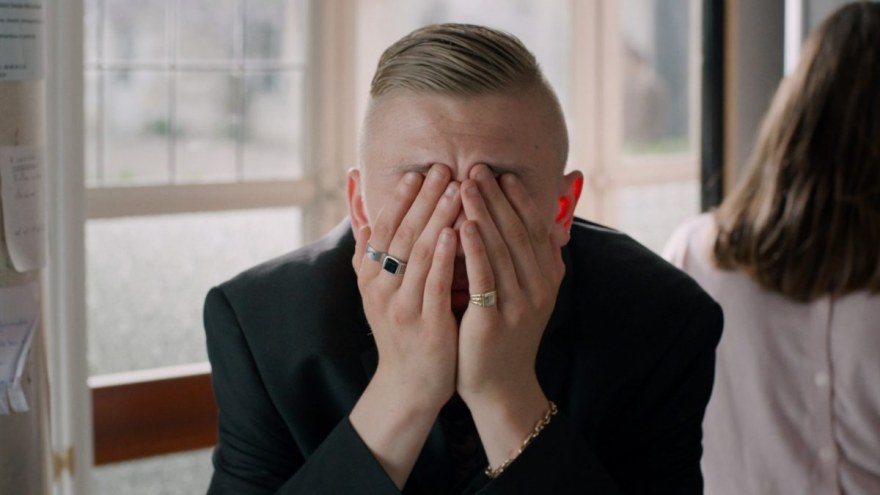
Interview with Antoine Giorgini, director of Réplique
 Where did you get the idea for Réplique? Were you familiar with the entrance exam for the Dramatic Arts, and were you especially drawn to the Theater?
I was mostly interested in talking about a type of character. I’ve worked in social centers in the North of France and the job left a strong impression on me. I’ve met a lot of boys without much sense of direction who didn’t know what to do with their lives, drifting from hope to stupid actions. That really affects me – young people with dreams just like everyone else but without the means to reach them, I think that’s sad. My first desire was to tell the story of one of those characters.
At the beginning of my studies, I did explore the theater, I read or watched many plays, but it would be hard to say that the theater has much place in my current life. What I really wanted to do was to let a boy like Tony loose in that environment and observe the differences.
Your character is familiar with two types of hearing: the one he gets for the entrance exam, and the one for the police. What place did you reserve for words in your film?
I think dialogue is the part I like writing the most in a script. The place I reserve for words… I’m not too sure. I mostly wanted to contrast two types of language, and I confess I have a certain admiration for people who speak, think and express themselves well. I wanted to see a guy like Tony reciting Shakespeare – I get a kick out of that, but I find it touching too. But that’s also some peoples’ dream. Nowadays, if you ask a young person from a good background what they want to do with their life, and they answer, “I want to be an actor”, you’re going to say, “Very nice idea… It’s tough but… Very nice idea.” If a young person from an underprivileged background said the same thing, you’d go, “You sure? I mean, I’m not sure that’s really up your alley…” That inequality of opportunities profoundly disgusts and saddens me.
Your main character is both touching and annoying. How did you manage to script that duality?
I like the way you’ve described Tony – annoying and touching – that’s exactly what he’s like. I really wanted to slap him upside the head, but aside from that, I had a lot of affection and respect for him. I just wrote situations and descriptions, so it isn’t really at the writing stage that I decide that, but more during casting when I really start building the character. I really wanted him to annoy the viewer, otherwise I don’t see the point. I didn’t want a popular kid who’s a bit of a thug, but kind, a sympathetic victim, fun, no, that didn’t interest me at all.
Did you write the film the way it is, or did you consider it a part of a larger whole, with a “before”, an “after”, a “why”?
Yeah, the film’s pretty close to what I had envisioned. I don’t get the “why?” in your question.
In Réplique, you show your character’s fear of disappointment, and the powerlessness he feels in trying to avoid that disappointment. Why did you want to show him fighting against the movement of time?
I don’t know, maybe I’m kind of cruel… I really wanted to put Tony in a tight spot, I wanted to use his nature (his impulsiveness) and the theater world to push him all the way to commit physical violence. That was necessary to evoke a strong sentiment at the end of the film.
Why did you want to show the different turns of event that led him to take the wrong road?
That’s how I thought up my script. I wasn’t trying to do a sociological study. I’ve already answered that to some degree in the previous question, but I wanted to get Tony into a mean fix, and in a short film, I think you’ve got to choose between action and reflection… I chose action. But that doesn’t mean that it doesn’t lead to a path of reflection.
Your character, who is in the midst of self-emancipation, seems to have broken off ties with his family, who are apparently not out looking for him. Is emancipation possible in this framework? Does it in fact require breaking off ties to one’s family?
I don’t know. There are so many different situations. In this film, I don’t think Tony is really cut out for the theater, but maybe it’s a step towards some form of emancipation, or at least of evolution.
As for is family, I’m not sure he has to break off contact with them, at least not any more than if he came from a wealthy background. If you take an example from a film like Billy Elliot, Billy himself needs to break free of his father in order go his own way, but I don’t think the script needs that. I think it’s aberrant to assume that you need to become a boxer and work in a mine to become a man. A lot of parents from underprivileged backgrounds actually push their kids to follow a different path than them, and obviously that creates a certain distance, but also builds very strong ties, gratitude and especially love.
How did you envision the adult characters and what effect did you want to display?
It’s true that all the adults in the film come out as authority figures, either teachers or cops. All I can say is that when you’re young, adults are meant to define limits, which you can fight against or not. Here, the adults are just doing their job.
Do you think short films are effective in questioning the meaning of “family” and of “macro” social units?
Everything depends on the script – everyone makes his own film and talks about the things that interest him. I think you can use short films to enquire about anything, I don’t think there’s a specific recipe for the genre. It’s very much a vehicle for pretty freely saying and doing whatever you want about family, society or any other topic.
Réplique was either produced, co-produced or self-financed with French funds. Did you write the film with this “French” aspect in mind: making movie references, building a specific context (in a particular region, for example) or inserting characteristically French notions?
It’s a Franco-Belgian co-production. I come from the Nord-Pas-de-Calais, and I’m very connected to my region, to its history and inhabitants. I didn’t have any particular references in mind when I was writing the script, I just let it come to me. At that point, I thought I wanted to shoot in the North of France. But we shot in Tours, and that worked fine. I think you can uproot a lot of stories, but I tell mine with all of my baggage – verbal, ideological, and even aesthetic.
.
Réplique is being shown in National Competition F4.