


Night cap with Shānzhài Screens
Interview with Paul Heintz, director of Shānzhài Screens
 How did you come up with the idea for Shānzhài Screens? And how did you find the artist painters?
In 2015 I made the film Non contractuel which deals with job transfers, unemployment and with simulation used as a way to get back to work. I was already interested in representations of work situations and behavior. When I found out about the artisans and the industry of copying paintings in China, I thought long-term about it. They’re artisan painters who work closely with the global business of copying paintings, most often canonical paintings from western art history. I naively wondered what these people in China dreamed of, painting in their studios and never getting the chance to see the fruit of the labors hang on a wall. They’re generally copies of works by the masters that are used to decorate hotels, shopping malls or are sold as souvenirs in the West or in Hong Kong. After trying unsuccessfully to contact a few of the artists, I corresponded at length with Wang Shiping through We Chat (an instant messenger used in China). My idea was to set up a correspondence involving paintings and drawings with him. Based on our discussions about life and his work as a painter-copyist, I commissioned oil paintings from him (not ones that were reproduced in large quantities). On my side, in a parallel, chameleon-like process, I started doing watercolors and also reproduced different images that he sent me. The origin of the project was more like a work correspondence involving painting and drawing than a film project. I was not at all planning to make a film in Shenzhen when I first got in touch with Shiping at the end of 2017. What I realized later on – and is of particular interest to me – is that there’s an aspect of infiltrating a sales system. At the beginning of Shānzhài Screens I play a client and Shiping is a painter-copyist and seller. Gradually things shift and something of the human connection and friendship begins to take shape, where the material convergence is doubtless the film, the moment of filming but also our future meetings.
Why were you interested in copies of works of art in particular?
With the quasi-industry of replica paintings made in China, I realize that what interests me the most is the question of the act and of the movement of the images. There’s nothing illegal going on, and it has nothing to do with a brilliant forger whose paintings are meant to be discovered and sold at auctions. What I wanted to show is how an industry of handmade copies of paintings like this incorporates the acts and histories of painting and offers a world that is as smooth and standardized as low-end, ready to wear brands. So I’m more concerned with deconstructing a part of the way that human techniques and acts are devoured by the industry and by business. My point of view is critical of the sales system since, as in other globalized systems, apart from the lacquer itself, we’re once again dealing with marginalization due to technology, loneliness and exclusion. So this is kind of like a portrait of the globalized worker, with me trying to pass on his imagination.
How many people did you film? Do they all appear on screen?
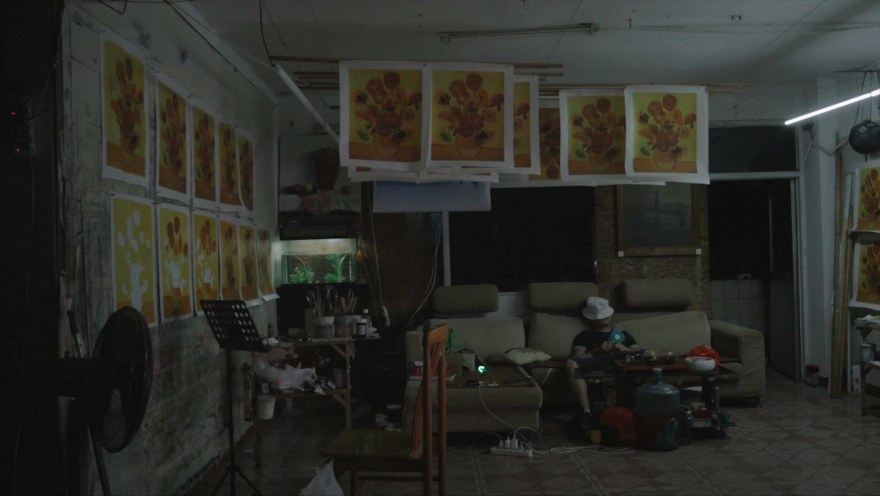
I filmed five painters and they do not all appear on screen. The one who appears most often is Shiping: from the scene of the copies of Van Gogh’s painting Sunflowers to him alone at home with the song on his mobile karaoke app.
How long did filming and editing take?
I was in Shenzhen for two months, from September to October 2018. Editing took about four weeks spread out at the beginning 2019, which allowed for rewriting and experimenting.
Why was it important to also talk about the connection with new technologies?
When I arrived in Shenzhen, I became aware of the peculiar and intensive way the Chinese use smartphones in their daily life. It’s much more widespread than in the West and can lead to new uses and strange situations. In particular for painter-copyists. After visiting several studios, I noticed that the image to be copied was displayed on a tablet or telephone. Most often, the copyist holds the phone in his left hand and a brush in the right. So archaic gestures (from brush painting) collide with technological positions (in relation to touch screens where you use your fingers to click, scroll or zoom). Originally, since the 1970s, Shenzhen has been known for counterfeiting well-known brands of mobile phones. The practice of falsifying became designated by the term “shānzhài” which means “copy”, “counterfeit”, but also “double”. There is also a shānzhài counterculture that misappropriates cultural objects to produce new artistic forms. After the singing scene in the film, we see Shiping painting not an image displayed on the screen of his smartphone but a telephone screen that is open, with its cables and electronic components exposed. The mise en scène is intended to make us slide from the platitude of the surface of the screens to the raw technological materiality of electronic devices.
Have you discovered any advantages that the short film form offers?
A documentary foundation and being able to enter the world of the people I film is very important to me. The advantage would most likely be the possibility of spending time with the artists, conversations before and during filming. I was lucky enough to be able to spend two months alone with Shiping and the painter-copyists, to live with them. My Chinese friend Zhenqian Huang who also spoke French helped me with the conversations. The time spent living together makes it easier for clichés and first impressions to give way to building other ones. I really like the way directing fosters reflections and the discussions that come out of it during filming. There can be a genuine transfer in documentary filmmaking: everything is implicit but there I am projecting myself onto the figure of Shiping and him trying to shift himself through my point of view.
Which works did you draw from?
While I was in China, I remember reading a book by Jonathan Crary, 24/7: Late Capitalism and the Ends of Sleep, which resonated with what I was witnessing. The book talks about the market’s effort to take over the night. From the military world’s influence to what place that can take up in our night life and even our dreams. Night falls earlier in China but the people tend to work much more at night too. That’s undoubtedly the reason I decided to set my film exclusively at night. That decision led to Shiping’s dream, which we filmed during a video interview in a taxi in Shenzhen. I was interested by the composition of situations and staging people’s words. They let us reflect on our physical state and the way new technologies modify our relationship to words and to the manner of telling.
Pour voir Shānzhài Screens is part of National Competition F1.