


Breakfast with Ennemis intérieurs
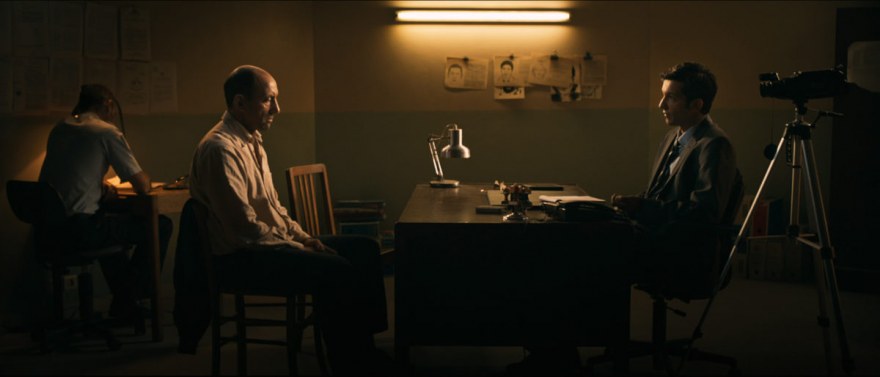
Interview with Sélim Azzazi, director of Ennemis intérieurs [Enemies Within]
. How did you come up with the idea for Ennemis intérieurs?
During my training as an actor, I worked on scripts which were based in the era of McCarthyism in the 1950s in the United States. I’ve developed a passion for the “witch hunt” phenomenon. During the hearings, the members of the House Un-American Activities Committee would ask this ritual question: “Are you now or have you ever been a member of the communist party?” In this American society weakened by fear, anyone connected to the communist party was suspected of sympathizing with the enemy and was excluded from society. The destinies of many men and women hung by a string tied to that now symbolic question. I thought about it and I realized that what fascinated me about that era was its parallel with the Algerian War that had left a mark on my family history. So, I looked for a narrative at the crossroads of the two: the Algerian War, the need to pledge one’s patriotic allegiance, to define one’s identity, terrorism, etc. The personality investigation, or “environmental investigation”, which is conducted following a naturalization request by a foreign national in France seemed like the perfect context.
Has the political situation changed at all for these former “French” from the colonial era?
I don’t know. The procedure for foreigners having lost French citizenship after having been French, and who wish to reacquire it still exists as far as I know. It is called “ré-intégration” (in fact, that was the provisional title of my film until the film by Philippe Faucon, “La désintégration”, came out).
Did you conduct any research on the motivations of real people applying for naturalization?
The question of national identity has always surrounded me on both sides of my family. Because of Algerian independence, I think that all Algerian families living in France faced questions from the administration concerning nationality. Among siblings, depending on whether they were born before or after 1962, in France or “in Algeria”, they could find themselves in very different situations. I was naturally interested in the different trajectories of specific individuals through written accounts or interviews, but for much of this film, I drew on my own personal knowledge of the subject.
Did you make enquiries about the actual naturalization process, or about the functioning of the police and the prison system?
I know a bit about the process from my family entourage. Once you file a request for naturalization, a background check will be conducted (especially a criminal background check). You are generally summoned to an interview at the police station closest to your house, or sometimes at the central commissariat.
Did you make enquiries about what takes place in these interviews? How and why did you imagine the pugnacity of the interrogating officer?
A few months before the shoot, I consulted a police commander who read my script. He shared his extremely valuable knowledge regarding the technical and human elements involved in police work. After our discussion, I found myself relieved of any doubts concerning the “realism” of my story.
For the interrogation, I did some reading on the work of the intelligence agency in charge of the surveillance of the movement of radical left-wing groups in the 1970s and 1980s. It was an extension of my interest in McCarthyism. At one moment, having been immersed in this reading, you start to know (or think you know) how your characters think. Here, the police officer is waiting for proof of the applicant’s patriotic commitment, with whom he identifies due to their common North African heritage. The officer doubts a priori the applicant’s sincerity. That’s where his pugnacity comes from and is connected to who he is: a French police officer of Algerian descent in the 1990s during the era of terrorist attacks linked to the Algerian civil war.
There is something theatrical in the duel in Ennemis intérieurs. Do you have a particular sensitivity for theater?
Yes, absolutely. I have done quite a bit of theater. I learned production and in part writing from my studies as an actor in the theater.
And what role did you want to give words in Ennemis intérieurs ?
Obviously, in Ennemis intérieurs, the action passes through words. I am a fan of the huis clos and the fact of having my characters confront each other through words. There’s nothing original about this device, but believe me, it’s difficult to do!
How did you come up with the question, “In ONE word, for you, what is it to become French?” How can we really give a one-word answer to define such a complex process?
It’s a question that police officers could ask during an interview and could be asked in these terms: “What does it mean for you to become French?” As I said regarding the House Un-American Activities Committee, to accuse someone based on a ONE word response fascinated me, so I applied it to this question. In Ennemis intérieurs, the police officer knows what he wants to hear and acts like a teacher who tries to guide his pupil towards the right answer.
What would it have changed if you had placed your character in a rural environment instead of a big city?
At first glance, nothing fundamental for me.
In Ennemis intérieurs, you question the need for answers and show the risk involved by this need, which is of course to accuse innocent people. Why did you want to question this need?
For me, what I wanted above all to highlight through the applicant’s character is the question of his trust in the police institution that is interrogating him in the name of the country to which he nevertheless wants to belong. The feeling of justice (or injustice) is fundamental here. If I trust the police, I have no reason to fear anything because I know that these questions exist for the security of everyone. If I have reasons not to trust, I remain on my guard and I give the impression of having something to hide.

Your main character evokes a double rejection by revealing the fact that he is considered a foreigner in every country to which he is connected. Why did you want to have him express this feeling?
Because this feeling is at the heart of my character. I wanted my film to invite us to some extent into the life of the applicant, hence the somewhat long exposition before actually getting to the conflict. This exposition seemed essential to give depth to the character.
Do you think that the fight against terrorism, the effort to thwart the planning of acts of violence, can lead to abuses such as unjustified accusations or denunciations?
Yes, of course. It is inevitable and we can see it clearly today in the situation we’ve been living since the 13 November attacks. The police are trying to make sure that mistakes don’t happen, but the injustice felt when it happens to you is devastating.
Do you think short film is effective in questioning the meaning of family and of “macro” social units?
Yes, of course! In the case of Ennemis intérieurs, the choice of the short format wasn’t a default choice. For me, I felt it was a story that corresponded well to that length.
Ennemis intérieurs was either produced, co-produced or self-financed with French funds. Did you write the film with this “French” aspect in mind: in building the film’s context or in questioning certain notions?
Not particularly when it comes to cinematographic references (one of my reference films was Una pura formalità by Giuseppe Tornatore). Concerning the region, as I am from Lyon I imagined the film happening in Lyon. In fact, I included it in the dialogues (see the references to the suburbs of Lyon). Furthermore, the prison I wanted to include is the Saint-Paul prison in Lyon which doesn’t exist anymore, but we shot a model created by Dan Ohlmann and shown at the Musée Miniature et Cinéma in the Vieux Lyon. So, we naturally requested funding from the Rhône-Alpes region (which is now Auvergne Rhône-Alpes…).
.
Ennemis intérieurs is being shown in National Competition F5.
The film will also be screened in the Reality Check programme at the Tampere festival (from 9 to 13 March in Finland).