


Breakfast with Cinq nuits (Five Nights)
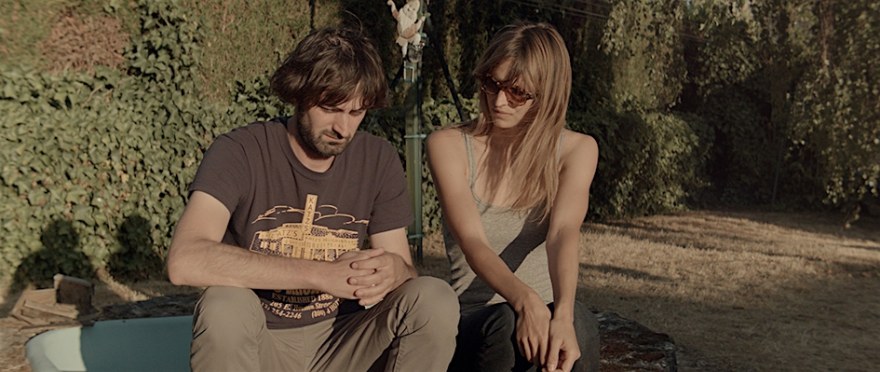
Interview with Guillaume Orignac, director of Cinq nuits (Five Nights)
 Why were you interested in the grieving period?
It wasn’t grief so much that interested me, but the way all of daily life’s affairs are put on hold for people who are most affected by the loss of a loved one. The starting point of the film is fed by anxieties, large and small, packed into this haunted house. The genre itself is both fantasy and melodrama: wherever there is a ghost, you will also find a child suffering and a family torn apart. Grief is this period of time, sometimes interminable, where one wants to do nothing but indulge this suffering. Except when they are interested in matters of inheritance, which is another genre, specifically French.
You play with the relationship to reality in Cinq nuits. Where did this idea come from?
I wanted to explore the styles we often see in the fantasy genre, without entirely going into the genre. In France, for historical and geographic reasons, it’s difficult to credibly tell stories with ghosts or monsters. So I wanted to blur the distinctions between what is real and what is hallucinated. And to not always elucidate where the border lies. Cinema is a medium that does this particularly well. Filming something gives it the weight of reality. But a film remains as a mental projection, a ribbon of imaginary elements. And, that is precisely the nature of these elements – to be real and unreal for the viewer. A film forms an implicit pact with the viewer: to believe in what they are seeing.
How did you create the mood for the house and its surrounding, from a visual and sound perspective?
For the visuals of the house, the pre-existing location imposed itself right away: The wallpaper, the old furniture, the half-lit shadowy areas, the way the house was built on many floors. With Lazare Pedron, the cinematographer, we chose to embrace what was there, sometimes accentuating it by bathing it in chiaroscuro light. The idea was to film the house as a constant battle between darkness and light, the voracious night and the robustness of daytime. The sound was a long and meticulous undertaking by Vincent Villa, the sound designer, working with material gathered by Bertrand Larrieu, who took sound on set. These sounds needed a lot of precise work, as some things needed to sound realistic, others more abstract. My choices were always made while in the momentum of the work, taking into account the input from everyone on the crew. The main intention was to go against a spatial reality for the sound, even and especially for the dialogue scenes. We hear very little echo or reverb, and dialogue can sound very close even though the characters are far away. For a long time, I’ve been obsessed with making people’s voices sound like murmurs, even when the raise their tone of voice. As if everything were sung in a low voice: joy, anger, and sadness. A film can sing in one’s own head, while they are lying in bed.
Why did you decide to compartmentalize the sequences? Was it to reinforce the feeling of alternating days and nights? And how did you establish the rhythm of Cinq nuits?
What you call compartmentalizing came from the choice of wanting to have successive ellipses: the usual connecting scenes were not included. Leaving them out helped to give this effect of taking the reality out of the events. I wanted us to always feel that what was filmed came from the protagonist’s point of view or from the little girl’s – even when the scene appears to be objective because of the simplicity of its shots. The idea was for the fantasy feeling of the film to come out of scenes that appeared to be insignificant. By the end, we don’t really know what was dreamt, what was lived through. Where each scene could be the imaginary double of another. It meant examining all of the scenes, at the risk of having a rhythm that goes against conventional storytelling.
In Cinq nuits you question paternity, ancestry, and brotherhood for the main character. What interested you in confronting these emotional bonds?
I don’t really question these bonds. I use them as a twisted knot of confusion for the main character: the death of the grandfather rekindles memories of his daughter. It provokes emotional flashes, as if it had awoken a repressed guilt, which was probably without any basis. It called for a kind of reparation, and it leads to the confrontation with his sister over the question of what to do with the inheritance of the mementos of their grandfather. Simon believes in a private and familial ethic while his sister believes in a more general and historical one. But Simon is a little mixed up, in fact. As is often the case when one suffers, one acts for the wrong reasons, and one doesn’t grasp the right ones.
Any cinematic coups de cœur in the past year you’d like to tell us about?
A film that came out recently that I discovered at Cannes’ Director’s Fortnight: Neruda by Pablo Larrain. Imagination as the malicious engine of reality, creative madness, the sensuality of his scenes and the vacillating identities of his characters, the immensity of his landscapes as an obtinate setting for the anxiety of our presence in the world… I like when a film presents itself like a cannon shot, mixing the high and the low, the obscure cultural references and the rawest sensations. Putting across tons and tons of fantasies through a grand audiovisual feast. That it should remain a singular enigma, revealed only to the viewer, through the universality of its spectacle.
If you’ve already been to Clermont-Ferrand, could you share with us an anecdote from the festival? If not, what are your expectations for this year?
I came in 2013 to present my first short film, Hotel Cervantes. A very different work than Cinq nuits, it’s a film that almost doesn’t have any scenes acted out. At the first screening, I heard an audience member say « This is not a film! ». The next day, I received a nice note in my mailbox from another audience member who wrote to say that this was exactly the type of film that he wants to see. So, I hope the festival will provide me with another mailbox this year.
Cinq nuits is being shown in National Competition F2.