


Breakfast with Clean With Me (After Dark)
Interview with Gabrielle Stemmer, director of Clean With Me (After Dark)
 How did you discover the “world” of YouTube?
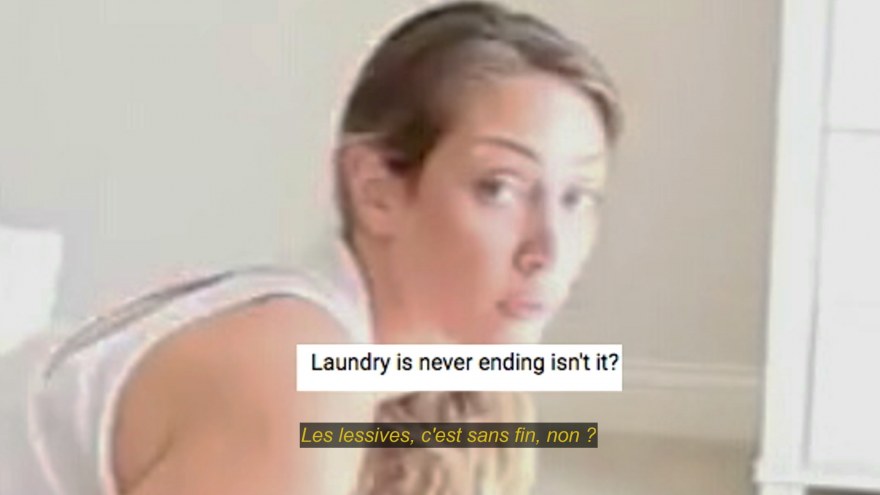
I’ve been a heavy YouTube user for seven or eight years now – it’s TV for me. I’d say that from the beginning I’ve been watching stuff that’s 90% female-oriented. I started with videos on beauty, cooking, interior decorating, areas that I only have a scant interest in in real life. The conclusion I drew from this paradox is that what interested me was watching how other women experienced their own femininity, and seeing how far the mental burden could be constructed as a life strategy. The videos relax me since I watch them with a certain detachment, and at the same time they awaken a sort of quasi-anthropological curiosity in me. YouTube’s algorithm decided it was time for me to explore the domestic side of the platform when CLEAN WITH ME appeared in my “recommendations based on my subscriptions”.
Did you contact any of those YouTubers?
I got into contact with each of the women who appear in the film, even if it was just to let them know that I intended to use their content. At the beginning of the project I was mostly corresponding with Jessica of “Keep Calm and Clean”, the YouTuber you see most in the film and who seesaws with the nervous off-camera of the cleaning videos. At the time, I’d talked to her about the project and suggested we meet on Skype later that year when the film would be further along. She was very open and enthusiastic but I ended up going down a different path that precluded that type of interview. I sent her the finished film by email, carefully explaining my approach and the viewer comments relative to her words, but she didn’t reply. I don’t know if she watched the film.
Tell us a bit about your cinematic choice. Why did you opt for this form of documentary (video montage, no voice-over, etc.)?
The topic and the form came together at the same time. And after I discovered Kevin B. Lee’s film Transformers: The Premake, which blazed the trail, there was never a question in my mind about making the film in any other way than as a “desktop documentary”. I was also lucky enough to be able to talk to Lee several times throughout the film’s production. The form makes it possible to get directly to the heart of the matter: the whole context is there on the screen, the images are connected to their manner of broadcasting but also to their position within a community. You also immediately put the viewer in a familiar environment that’s part of their daily life as an internet user. That’s why I made my narrator’s presence more and more discrete throughout the editing process, in order to reinforce the viewer’s identification with the consciousness that clicks. They forget the narrator-clicker in favor of the women who appear one-by-one on the screen and whose words I wanted them to hear. That’s also why I wanted there not to be a voice-over. I wanted the film to move forward exclusively through the mouse, the keyboard, the windows that open and close, I wanted the viewer’s gaze to be guided by the silent narrator, to be led on almost despite themselves, in a relentless march. Doubtless that was partially due to my fantasy as an editor, which is my initial calling, creating meaning exclusively by organizing images, their sequencing, their placement, their relationship to sounds.
These types of videos mostly come from the United States.Why do you think that is the case? Is the trend spreading?
That’s a very good question. It’s tempting to answer that American YouTubers make up the majority of this type of production on YouTube, but that’s difficult to say given that through their algorithms, YouTube, like social networks in general, only show us what we’re in the habit of watching. There are French housekeeping videos, for example, but they either copy American ones with less success, or they play on another niche that is more natural and biographical, which is very interesting but also very different. What made me want to use the American images was the fact that they all look the same. It was the uniformity of their appearance and of their houses that made me want to make a film about these women, because that produces infinitely meaningful images. Yes, of course, the trend is spreading and in quite vicious guises, which don’t balk at using feminist terms, or the very trendy word “empowering”, to spur a return to the hearth that I personally find very disturbing.
What would you like people to take from your film?
I think we need to be educated about how we watch widely-broadcast audiovisual productions that are now part of our daily life and that we easily take in without sufficient distance, and that is problematic. Despite my own relatively detached way of consuming them, I can clearly see that these videos grew on me, and I was surprised to find myself under the influence of the influencers. What sort of role model do the images of women on YouTube channel for teenage girls? You only have to take a look at the comments under the videos to realize how big the problem is. At the same time though, there’s hope on social networks and I don’t think we should belittle their documentary benefit, which is something I wanted to show through my film. On YouTube and Instagram, women can express themselves without an intermediary, and on a large scale, two conditions that up to now have been inaccessible to women. What’s at stake is genuine freedom of speech, especially with regard to topics that are typically feminine. My film addresses isolation and psychological suffering, but there are also many new voices to be heard about giving birth and about sexual violence.
Have you discovered any advantages that the short film form offers?
Shorts make it possible to give a hint of something, to experiment. I’m not sure this type of narration could sustain a longer format… I’ll think about it though. I think the fact that it was a short helped me to not try to be exhaustive and stuff everything I wanted to say into the film, and to privilege saying things clearly and making the development efficient. Shorts are less definitive than feature films and allow you to tell yourself that you’ll get to everything else later.
Clean With Me (After Dark) is part of National Competition F5.