


Breakfast with Quebramar
Interview with Cris Lyra, director of Quebramar
 Could you tell us a bit more about the title?
A “quebramar” or breakwater is a wall of rock built to resist the strength of waves or currents that seek to wash over a piece of land. In our conversations about being a lesbian body in the patriarchy and about not performing standard femininity, we identify with this image (which was in a poem written by Lana, one of the characters) of this body wall constantly resisting so it can be itself.
How did you go about approaching all the people in the documentary? Were they all happy to take part and talk openly?
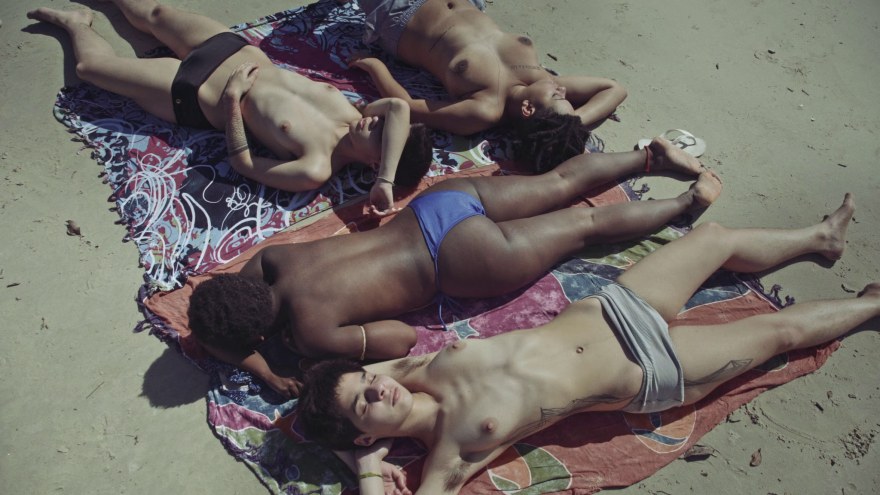
We arranged a few rounds of beer to invite the girls to be part of the film. The proposal was one of collective creativity, seeking to talk about our bodies, feelings, desires and fears. They were immediately really into it, especially in view of the lack of films made by lesbian women and which portray us in this way, without romanticising or fetishizing or any of these harmful things that are reproduced when men try and talk about love between women. Camila – the producer and assistant director of the film – joined me in spending time with the girls, who started inviting us to almost everything they did, and they invited us along for New Year’s Eve with them at the beach. We went and did some filming. The following year, we were all friends and we met up weekly or every couple of weeks to create together. It was always enjoyable and productive in terms of the conversations, but we could not find the film itself. I was expecting a steer to come from them, and they, quite rightly, expected it to come from me. I decided to look at the material from the beach – it was a study with no direction – but it ended up showing us the way ahead. I understood that the film would be set there, at the beach, and not in São Paulo, so we decided to write the script based on that material. We went back there eight months later to finish filming. Each of them decided what they wanted to say. I made suggestions, based on conversations we had had throughout the process, stories they had told, and which had an impression on me for some reason. But it was their decision. It was a long process of meetings and conversations. When it finally came to filming, we were totally committed and really keen to make it happen. We really trusted each other.
Did you guide the discussions at all? How much improvisation is there?
Some scenes, those from the first stage of filming (in which we just filmed stuff without knowing what would come of it) are totally improvised. The New Year’s Eve party, for example, and the moonlit beach party. Most of the spoken texts were decided in advance. In addition to the content, we decided which context each conversation should take place in, whether on a bus, at the beach, cooking etc. For me, there was this concept of which part of the film, chronologically, each theme would be most relevant to. For example, I always wanted the first scene to be about wanting to be a woman without having to perform the role of the standard woman which is imposed on us, almost like a prologue. That’s why I asked Lana if we could do the scene on the bus, which was most likely to be the first in the film. She agreed. But they’re her words, her story and she told it as she saw fit. And that’s the way it was with the others too.
Are these conversations happening more and more given the current political context in Brazil (the recent election of a conservative leader)?
Ever since 2013, the Brazilian political arena has been a mess and is increasingly polarised. In this environment, it’s natural that these conversations increase because on the one hand there is a reactionary right wing in full control, who wishes to extinguish diversity, and on the other hand there’s us (and all the people who don’t match the ideal of the right – black people, indigenous people, artists, LGBT people) and we need to organise and defend ourselves from constant attacks. Quebramar was conceived in 2017, one year before the election of Jair Bolsonaro, and was finished about the same time he was elected. It does reflect that moment, but not only that. We were all talking about experiences from throughout our whole lives. The patriarchy has always been violent with women and even more so with lesbian women. Finally, I’d like to say that the girls in the film are from a generation of young people who are much more aware and politicised than we were at their age, and they were already having conversations about these things long before the film.
Can you tell us more about your background as a filmmaker?
I completed my degree in Cinema in 2009 and from 2010 onwards I worked on several productions in the photography department, as a camera assistant at the beginning, then as a photographer. I am, first and foremost, a director of photography, and that’s great. Every director I work with teaches me a lot, and I’ve been very lucky in that regard. I filmed three motion pictures (Chão/Landless by Camila Freitas, Lembro Mais Dos Corvos/I Remember The Crows by Gustavo Vinagre and Paraí by Vinícius Toro), one TV series, Noturnos, directed by Marco Dutra and Caetano Gotardo, and several short films.My experience as a lesbian woman motivated me to develop and film Quebramar, as these were issues that I need to get to grips with myself.
Are there any works of art or films that have inspired you?
A Vizinhança do Tigre, a film by Affonso Uchoa, had a huge impact on me in terms of expanding the language of documentaries.
Would you say that the short film format has given you any particular freedom?
I have never directed a feature, so I don’t know exactly what the challenges are in comparison to a short film. However, I imagine that the format of Quebramar – which for me is a visual and poetic essay on bodies and their narratives, without grand endings or sweeping conclusions – is more acceptable in the universe of short films.
Quebramar is part of International Competition I7.