


Night cap with El afilador
An interview with James Casey, director of El afilador
 It’s a very tender, sweet story glimpse into someone’s life. Where did the idea come from? Is it based on someone you know?
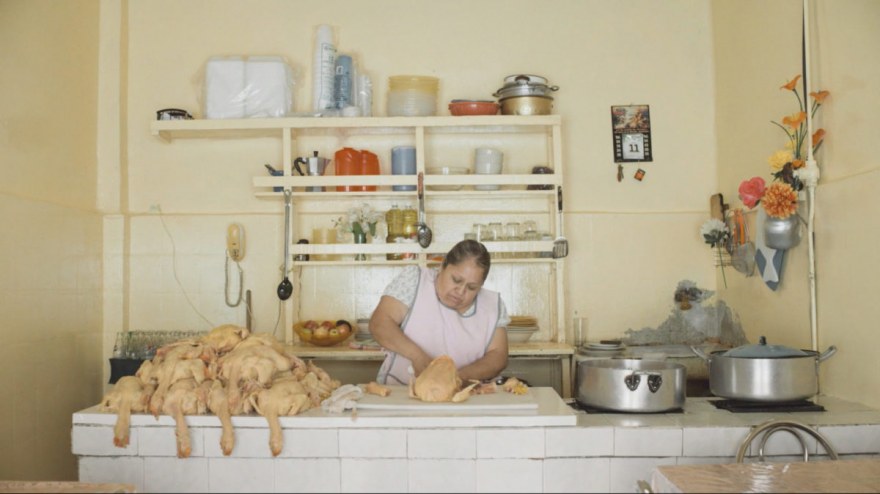
The idea came while I was working on another project in Mexico about all the sounds of the city. Each city has a unique sonic fingerprint, and Mexico’s is more chaotic than most. Over the course of that shoot, I became interested in the knife sharpeners and their whistles that let customers know that they’re in the area. Quite a few of these guys were handsome and I thought it would be funny to create a character who yearns for her sharpener in a naive romantic fashion, and then deliberately dulls her knife in effort to see him more often. It’s not based on anyone I knew,
Can you tell us more about the cafe itself? Is this a real, operating cafe? Did you know this location already?
We started to scout for locations and nothing was quite right up until we saw that space. I wanted to make sure the setting was in a neighborhood that wasn’t too modern and gentrified but also had character. The line producer proposed this market area with several small ‘fondas’ on it that was right behind the Bellas Artes building. At the time, this one was empty and served as the perfect location as we could dress it as we liked. Some workers were in the middle of painting it that cream color, so I asked if they could leave the sink area unpainted as a detail. All the objects in the room were borrowed from other cafes on the street. I’d love to see it now, and see how different reality is from the film.
Can you tell us about the casting process? Were there non-professional actors involved?
Both the actors are non-professional. I met Lupita and José Luis beforehand. She was working in a bakery near where I was staying at the time, and he was a waiter in a restaurant. When I was casting the film, I kept meeting “real” actors but none were quite right and I kept thinking that they were both the perfect look for the roles. After not finding anyone, I asked them if they’d be in the film and fortunately they both said yes.

How was your experience shooting in this street?
It wasn’t easy! For one, the space next door was an operational tortilla factory with a huge noisy tortilla machine. We scouted on a Sunday, and weren’t told about it by the owner. When we turned up on set, the noise was constant. We tried to get them to pause between takes, but they ended up getting super annoyed. Also, the neighborhood is a bit rough, and at one point someone came up to demand protection money from us. Our security shooed him off, and the neighboring cafés assured us it would be OK, but he did threaten to come back later on with his gang. Fortunately, the café’s owner made some calls and straightened it out.
How did you pick the soundtrack?
My initial thought was to find songs that had a certain sentimental romantic « naïveté » to them. We had another song originally in the edit but it was by the “Frank Sinatra” of Mexico and way out of our budget. The film’s music supervisor, Herminio Gutierrez found these two which worked out better than what we had in place. I wanted the music to be diagetic throughout the film, so that we get a sense that Lupita is listens to romantic songs as she dreams about another life. But then, when their hands touch I wanted the music to feel like the soundtrack that plays inside her head. Like listening to all this stuff creates her own sense of reality.
What sort of freedom would you say the short format allows?
It’s been a great way for me to work on ideas, and flesh them out in a satisfying manner. In this case, I was able to make a hermetic film about a café worker in Mexico City which in itself is super exciting. You’re not bound by conventional thoughts on structure which is a huge joy. The last thing I think is really interesting is that many shorts can be successful through what they don’t show as opposed to what they do. Good shorts leave me with more questions than answers.
If you’ve already been to Clermont-Ferrand, could you share with us an anecdote or story from the festival? If not, what are your expectations for this year?
It’s my first time and I’m really excited to see lots of films and meet other filmmakers, producers, and more. From what I’ve heard, the energy is fantastic and it’s THE place to see short films.
El afilador is being shown in International Competition I2.