


Lunch with Teen Horses
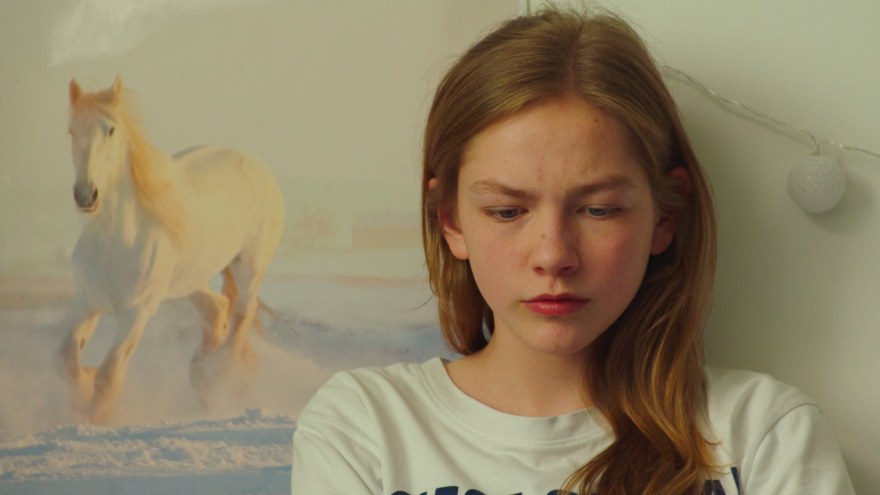
Interview with Valérie Leroy, director of Teen Horses
 What interested you about the period of adolescence?
I’m very interested in questions of identity: How do we become who we are? How can society influence our development? To what degree are we free? And in that regard, adolescence is truly a watershed period. And also to what degree we’re able to construct ourselves despite / against or with the judgement of others, which tends to be very strong during the teenage years. It’s also a moment when desire, fantasies and the birth of sexuality occupy an important place – I was also interested by that. How young girls occupy that terrain, entering a period where they begin listening to their bodies. And there’s also a very small part of Proust’s madeleine because adolescence is also a moment that we fantasize about and long for as adults. My teenage years were quite complicated for me in relation to myself so I also think it was a way for me to take a gentler look on my own past by putting little bits of myself into each of the characters in the film.
Are you thinking about making other films with teenage characters?
I loved working with the teenagers. They were truly wonderful and it was really a pleasure, so just to relive the experience, yes I would. But after that, there have already been many very lovely films about adolescence so you really have to find an angle and a particular story.
How did you find your actors?
Through auditions. My casting director and I auditioned a mix of actors coming from agencies and others in open casting calls. I saw all of them first individually and then we saw them in small groups because the chemistry had to be right.
Did you specifically have in mind a situation involving a French-Finnish girl, or was it more about dealing with inner balance when large events disrupt life?
My primary goal was to talk about uprooting, what it does to you at that age when friendships are really strong and when you might have managed to create a little protective cocoon for yourself in dealing with the world – to be taken away from all that. Tania has to deal with her parents’ separation, with going to a new high school where she doesn’t know anyone and a new culture, because the differences in the educational systems in France and Finland are pretty significant. I wanted to talk about that, a world that’s crumbling and how we’re able to build another one by breaking through our own prejudices. Almost like in mourning.
How did you learn about the sport? How much time did you spend on the body movements?
I found a video on the internet. Digging deeper, I discovered that there’s a real feminist dimension and empowerment in what those young girls in Finland are doing. Most of the girls involved in it have had difficult teenage years and practicing the sport has helped them build themselves up. And all that against how others view them: they know that what they do bothers others and sets them up for derision, but they own it together and grow up together. I think that’s courageous. As for working on the movements, we didn’t have much time, but I’d sent Elsa Houben, the actress who plays the main character, videos to look at and she spent a day with a choreographer, Georgia Ives, to work on the moves at the beginning and the end of the film.
Why were you interested in the style of clothes that you gave the characters?
I wanted to play with teen movie codes where the characters often have pretty pronounced looks. My costume designer, Sarah Billand, and I had quite a bit of fun coming up with a clearly defined look for each character. And I also wanted there to be a trans-generational side too. Some of the looks are from my own adolescence in the 90s and yet they still work today.
How did you learn about the song “L’escalier” and what did you like about it?
I discovered it as I was editing the film. My editor, Julie Delord, and I were looking for a piece of music for the training scene in slow motion and we chanced upon the song. We put it over the film’s images and it worked beautifully. I really like the electro sounds and I thought the words could resonate with each of the characters, and beyond that, that’s what I really liked.
Have you discovered any advantages that the short film form offers? Can you see yourself making a feature film version of Teen Horses?
The greatest freedom I find is in being able to choose my crew and my actors. I was lucky that my producers left me very free to make my artistic choices. And there’s also a form of freedom in the act itself, as shorts are quicker to write and rework than feature films and they can be financed in a shorter time. The form corresponds very well to my type of energy. If I had to adapt Teen Horses to a longer format, it would most likely be as a television series so there would be enough time to dig a bit deeper into the world and the supporting characters. It would also most likely be a musical TV series because I love the idea that my characters find another form of being through singing and movement.
Which works did you draw from?
Only taking into account films about teenagers, I’d say Fucking Amal by Lukas Moodysson, Riad Sattouf’s The French Kissers, Ghost World by Terry Zwigoff, Life Doesn’t Scare Me by Noémie Lvovsky and Paweł Pawlikowski’s My Summer of Love. Some of them were a big part of my own adolescence.
Teen Horses is part of National Competition F2.