


Dinner with Notre Dame des Hormones
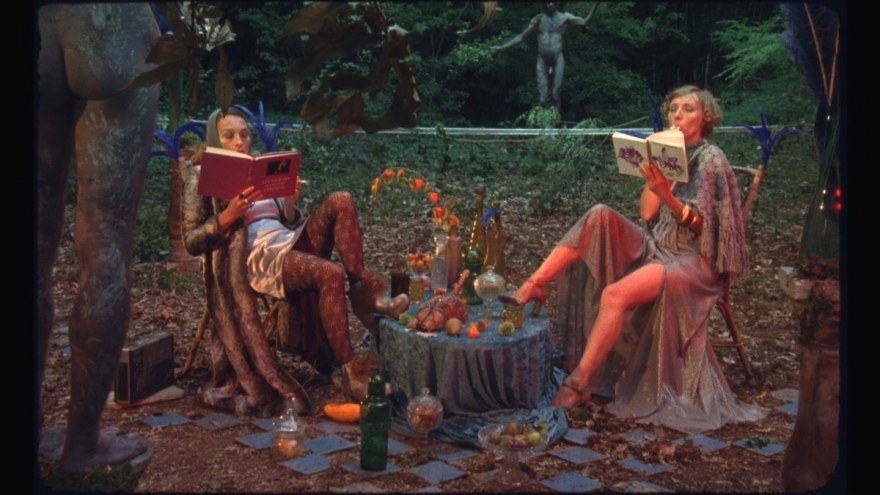
An interview with Bertrand Mandico, director of Notre Dame des Hormones [Our Lady of Hormones]
 Had you already dealt with filial relationships in your earlier films?
Yes, Boro in the Box also dealt with filial relationships…
In that film, there was a pregnant mother who throws herself into an abyss to rid herself of the child; the same child (who survived) who fantasizes about her mother being physically in love with a horse; a father initiates his son to voyeurism; and then that son becomes a filmmaker and is frustrated at not being able to show his films to his parents… All of that formed an imaginary portrait of one of my cinematic fathers, Walerian Borowczyk.
I have peculiar relationships with my cinematic fathers and mothers – everyone who fed me copiously, and whose breasts I continue to drain of blood…
Why did you choose two female actresses as characters? What is your relationship to the world of the theater?
Realism in film (for me) is filtered by the mise en abyme of the film’s construction (which is often fantasized). According to that logic, a stage actor (who is comfortable as an actor) is my ideal protagonist. Dramatic actresses and actors fascinate, amuse and distress me (especially when they are captivated by their roles). Like everyone, I always wanted to be an actor, but I play on the other side of the camera fixing the image, invisible.
With Notre Dame des Hormones [Our Lady of Hormones], my first intention was to write a film specifically for Elina Löwensohn and Nathalie Richard. They form a truly intense and funny duo in the theater (and in real life). They’re sufficiently self-deprecating and crazy to dive right in to an organic project like Notre Dame des Hormones. It was exhilarating to work with this incredible tandem… They do not hesitate to play with their own image to the point of twisting it out of shape.
When I came up with the two main characters, I was thinking of several memorable films that deal with the twilight of an actress (or artistic menopause): Whatever Happened to Baby Jane by Robert Aldrich, Paul Vecchiali’s Femmes Femmes, and obviously Rainer Werner Fassbinder’s Veronika Voss and Billy Wilder’s Sunset Boulevard… During the filming, I conjured up the combined memory of those films.
In Notre Dame des Hormones, you probe the relationship between flesh, in its most concrete nature, and the physiological reality of the animal side to human beings. Did you use psychosocial analyses in your development of the film, or research on endocrinology, or did you envision the film as purely a work of the imagination?
My relationship to flesh in all its states is purely sensory. I’m amused and fascinated by the question of hormones, as a natural key to mutation or metamorphosis. The film never really says that the women were once men, or that the men are women, or that the does are transsexuals, but you get the hint in the course of a sentence. You can definitely see the hormonal mutations in the world created around the actresses…

Would you have liked to be able to lengthen the film to address the question of people who take hormones to transform themselves (such as transsexuals or athletes)?
I have several projects about sexual transformation, but they are quite distant from medical realism. If there were a sequel to Notre Dame des Hormones, the two actresses would face off against a young rival who had become the creature’s favorite… An uninhibited, one-eyed young upstart.
Your characters are faced with a pretty peculiar living creature with whom communication is not possible. Why did you choose to give this creature neither a name nor the gift of speech?
The creature is a cross between a mollusk and a mushroom; it’s an autonomous organ. It seemed important to me not to make it quite animal in order to keep a certain distance with the viewer, no possibility of anthropomorphism or empathy… At the same time, it is able to communicate: the creature reacts to touch and expresses itself in a language that is intelligible to one of the two protagonists, sort of like a phlegmy, melodious wheeze (an echo from a certain type of fantasy film from the 1980s).
Notre Dame des Hormones is built on chapters. How did you conceive the film’s narrative evolution, and why?
The chapters begin with organic illuminations, where the narrator (Michel Piccoli, who is the absolute incarnation of an actor) tells us what we are about to see. This process of “pronouncements” allows me to play more easily with destructuring the narrative. The story evolves by sensory fits and starts, or by repetitions of actions and jumps in time. It’s a mental structure that is not at all experimental – I drew heavily on some of Alain Resnais’ films, and George Roy Hill’s Slaughterhouse-Five…
Notre Dame des Hormones manoeuvres through a world where the notions of repetition, games and seeming are part of the daily routine of two actresses preparing for a hypothetical play.
Notre Dame des Hormones plays on desire, eroticism and our projection onto others of our sexual longing in them. Do you think that the concept of decency – which demands that we control these desires, games and projections – makes sense and “is enough”?
No. Decency is a tedious, puritan concept.
With Notre Dame des Hormones, I wanted to explore a view of eroticism that goes against the grain, moving the object of desire onto a cutting of evocative, autonomous organs. This piece of flesh that resembles nothing may very well be the incarnation of indecency for some people.

In the film, we hear the Everly Brothers’ song “Torture”. Why did you choose precisely this song?
I discovered the song in Kenneth Anger’s film Scorpio Rising. This treacly piece with its cruel refrain seemed ideal to end the film, where desire and torture cohabit in a colorful, baroque jewelry box.
And, in your preparatory work on the film, how did you end up thinking that desire could be a form of torture?
As I wrote the dialogues, I played with the pairing of desire and cruelty. As the situations got more and more out of control, torture made its appearance. I decided to literally stage “the torture of desire” in the scenes without dialogue.
In sexual relations, orgasm can be unequal: it happens that only one partner is able to enjoy at the other’s expense. In your opinion, can romantic relations be fulfilling when orgasm is not mutually assured?
Vicarious or indirect orgasm is possible: it’s like the difference between French billiards and American pool (if will you allow me the metaphor). But the person who has the indirect orgasm may experience several contradictory states in order to achieve fulfillment… That is very far from being ideal.
Lastly, Notre Dame des Hormones was produced in France. In your opinion, what does the French film industry offer that others don’t, as far as short films are concerned?
Everything depends on the producer, not his nationality. Far too many producers are hesitant in the international domain, or they are bereft of artistic vision. For this film, I benefited from French assistance and support, for example from CICLIC, France 2 in the person of Christophe Taudière, and finally from the determination of an iconoclastic producer, Emmanuel Chaumet. Everyone was very respectful of my choices and of my desire to make a febrile, uninhibited film. Without them, I would not have been able to concretize Notre Dame des Hormones.
Programme for viewing Notre Dame des Hormones: National Competition F1.
More info The film will be screened at other festivals such as Indie Lisboa…